Exoskeletons and robots for handling objects — Reference Guide
Scope: objects only. This guidance covers the handling of inanimate objects, materials and loads.
Technology may assist selected object-handling tasks or remove a repeated movement. First consider task redesign and the whole system. A product claim, trial or deployment announcement is not proof of long-term injury prevention.
Wearable exoskeletons
Passive devices use mechanisms such as elastic elements or springs; powered devices use actuators. Manufacturer examples include the passive Auxivo LiftSuit and powered German Bionic Exia. HUNIC SoftExo is another passive product family; it is distinct from the Auxivo and German Bionic examples.
A wearable may assist a particular movement yet shift pressure, restrict movement or affect balance. Fit, comfort, other protective equipment, different tasks, cleaning, maintenance and emergency arrangements all need assessment. Do not increase an individual's lifting allowance because a device is worn. NIOSH explains the potential benefits and uncertainties in Industrial Exoskeletons. Suitability depends on the real task and worker feedback; short-term measures such as muscle activity or perceived effort do not establish long-term injury reduction.
A 2025 study by Kazemi, Shayan and Srinivasan compared repetitive box lifting in 16 participants with no exoskeleton, a passive device and a powered device. The powered device improved endurance and reduced perceived exertion compared with no device; neither device significantly reduced back discomfort. This small, task-specific study did not demonstrate long-term injury prevention.
Reported uses of robots
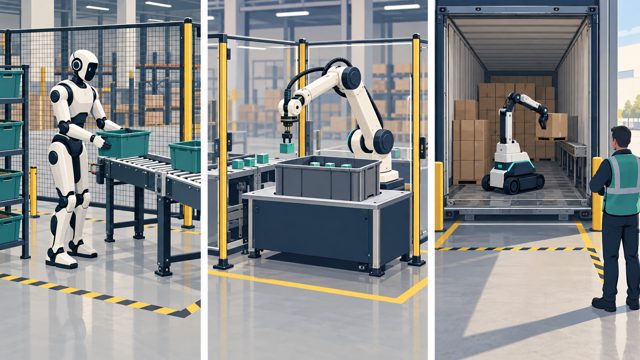 Examples of tasks robots can perform. This illustration does not depict any named product. Generic course illustration.
- GXO reported a commercial deployment of Agility Digit following a pilot, transferring totes onto conveyors. See its 2024 deployment announcement.
- Amazon describes Sparrow for individual-item picking and handling in its operations robotics account.
- Boston Dynamics reports Stretch deployed for DHL container unloading. Its subsequent memorandum concerning more than 1,000 additional robots describes planned expansion, not a completed installation of that number. See the 2025 DHL announcement.
- Robotic arms can be considered for repetitive packaging or transfer. This is an application category, not evidence of a particular local installation.
New equipment means new hazards
Consider unexpected movement, impact, crushing, trapping and electrical hazards, together with people entering the operating space during faults or maintenance. Follow assessed separation, guarding and access controls. Only authorised people should clear faults using the agreed safe isolation procedure. A robot working near people is not automatically safe because it is described as collaborative. See NIOSH workplace robotics guidance.
Related Topics
Further Information
Google Reviews
“Highly recommend. Sarah was lovely and delivered the course perfectly!”
Adele Collier“Great experience and very happy with the corse. Sarah delivered all aspects of the couse clearly and professionally. Loo…”
Phil Lawson“The course was extremely interesting and delivered perfectly”
Ryan Garrick“Sarah delivered the course to a high standard. Good interaction with the class and very good practical provisions.”
Neil Lefley“Couldn't of been better”
Shaun pearsall“I went onto the first aid at work course for 3 days something I was very sceptical about but right from the start Sarah …”
Daniel Connolly“Wonderful experience and met a great bunch of people. Learnt a lot and can now go ahead and put it into practice if ever…”
Spannerman“Great 3 days training from Sarah, thanks!”
Ric Smith (UK JL fan)“This was a very informative and comprehensive course. Sarah was brilliant and explained everything in layman’s terms as …”
Tracey Goodwin“The course was delivered and set at a pace that was suitable for beginners and experienced first aiders. Sarah was a rel…”
Joe Carter“Well planned, well presented, enjoyable. Sarah made me feel relaxed to engage in the course. Very informative and enjoya…”
Maria Clarke“Olly was amazing in making sure we understood everything and made sure we were all very involved”
Jackson“Great training by Olly”
Adam Hardcastle“Great session Olly was fantastic.”
Liam Duckworth“Olly was great, really informative”
Ella Souter (BR_Killjoy)“Olly”
Martin Clegg“olly was great!!!!!!!”
Emily Vidler“Olly was a fantastic trainer. He made the course fun and easy to understand. I really enjoyed the practical parts of the…”
claire thomas“Olly White was a great trainer, clear and engaging. Involved all the participants and answered all questions. Thanks”
T