Trolleys, trucks, hoists and access aids for handling objects — Reference Guide
Scope: objects only. This guidance covers the handling of inanimate objects, materials and loads.
An aid must suit the object, person, route and task. Check rated capacity, condition, stability, controls and brakes where fitted, clearances, destination, maintenance and required inspection status. Use equipment only with appropriate instruction, training and authorisation. Capacity alone does not show that pushing force is acceptable.
Platform trolley
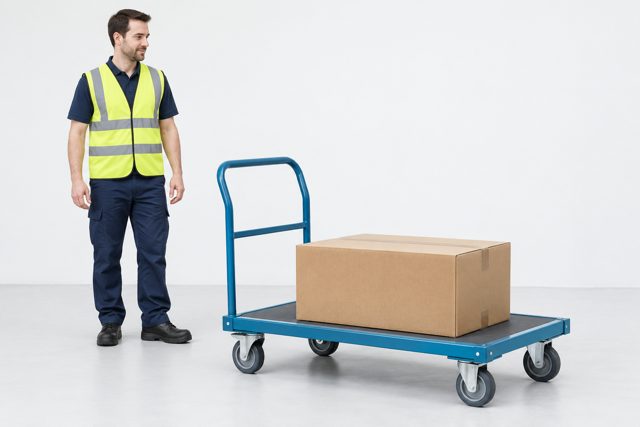 A low deck can take several boxes; consider the loading height and whether the load obstructs the view. Generic course illustration.
Useful for moving several stable boxes across a suitable floor. Starting, steering and stopping still require effort. Check castors, visibility, load stability, thresholds, doors, slopes and pedestrian traffic. A stiff castor or blocked view needs action before use.
Raised or high-deck trolley
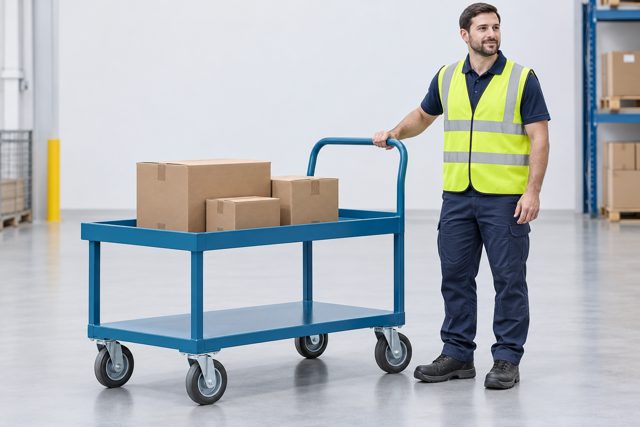 A raised deck can reduce bending during transfer. Check stability at the chosen height. Generic course illustration.
A high deck or shelf can present small items nearer waist height and reduce repeated low collection. This is not a powered high-lift truck. Check transfer height, stability, braking and view ahead: a higher stack can block sight or become unstable.
Sack truck
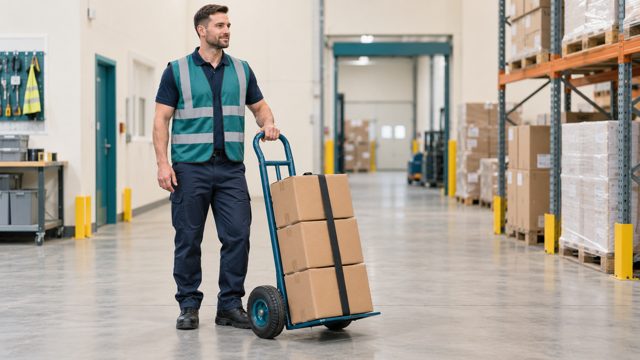 The toe plate supports the load; its shape and securement affect control when the frame tilts. Generic course illustration.
A suitable upright object can be wheeled over a checked short route. Confirm shape, securement, toe-plate fit and wheel condition. Tilting and balancing introduce tipping and hand-trapping risks. Steps and slopes need specific assessment; do not treat stair climbing as routine.
Pallet truck
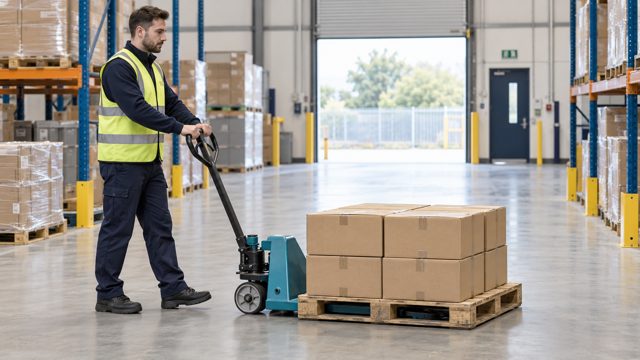 Small wheels, thresholds and floor condition affect the effort needed to move a pallet. Generic course illustration.
A stable compatible pallet can be moved without hand carrying individual cases. Check pallet condition, load security, floor, gradients and space for the operator's feet. Small wheels can catch on rough surfaces or thresholds. HSE warns that RAPP may underestimate some small-wheel pallet-truck risks on rough or sloping routes. A simple truck that only raises a pallet clear of the floor is generally outside LOLER but remains under PUWER. See HSE pushing/pulling risks and the LOLER scope.
Goods or material hoist
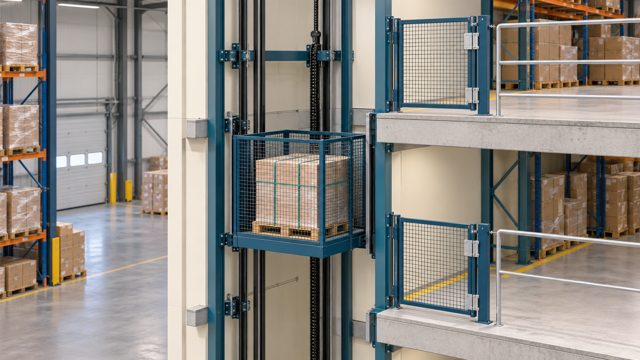 A goods-only hoist moves materials between levels. It must not be ridden. Generic course illustration.
A suitable goods hoist can remove a carry between levels. Raised loads, landing gates and trapping need controlled operation. Confirm capacity, landing arrangements, competent operation and required examinations. Do not ride a goods-only hoist. Operation requires equipment-specific instruction and authorisation.
Lift table or conveyor
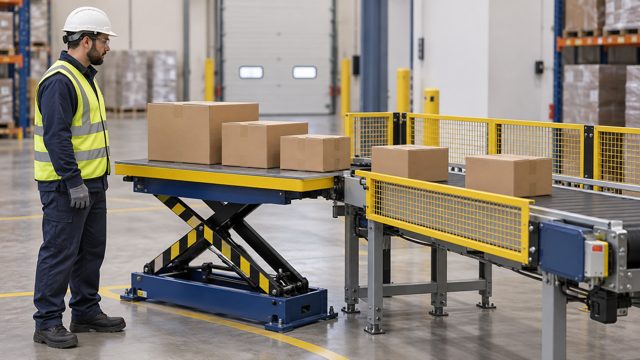 Matching transfer heights can remove repeated lifting. Moving parts introduce trapping points. Generic course illustration.
A lift table can bring collection or set-down to a suitable height. A conveyor can remove repeated carrying. Assess pinch, crush and entanglement points, guarding, controls and safe fault-clearing arrangements. Users must not reach into moving machinery or attempt unauthorised repairs. PUWER applies; whether LOLER also applies depends on the equipment. See HSE PUWER guidance.
Steps, step stools and stepladders
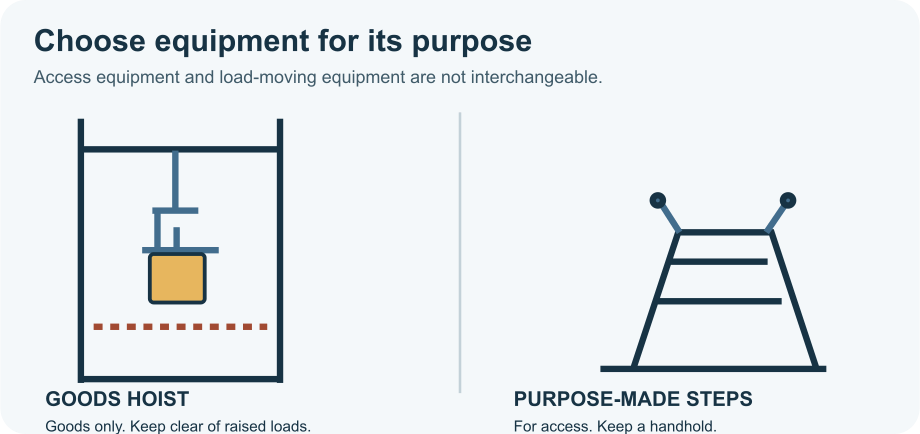 A goods hoist moves loads under controlled procedures; purpose-made steps provide access for suitable light, infrequent work.
Access aids help a person reach a place; they are not heavy-load lifting aids. First reorganise storage to avoid height. Where suitable for assessed light, infrequent access, use purpose-made checked equipment on stable ground, avoid overreach and maintain three points of contact where possible. Do not ascend with a box occupying both hands and never use a chair. Forklifts and high-lift stackers need trained, authorised operators. See HSE working at height.
Checks are different from thorough examination
Pre-use checks and maintenance do not replace statutory thorough examination. For relevant goods-lifting equipment the usual regular interval is 12 months, while lifting accessories are usually examined every six months, unless a competent person's examination scheme specifies another interval. Other circumstances can also trigger examination. See HSE thorough examination guidance.
Related Topics
Further Information
Google Reviews
“Highly recommend. Sarah was lovely and delivered the course perfectly!”
Adele Collier“Great experience and very happy with the corse. Sarah delivered all aspects of the couse clearly and professionally. Loo…”
Phil Lawson“The course was extremely interesting and delivered perfectly”
Ryan Garrick“Sarah delivered the course to a high standard. Good interaction with the class and very good practical provisions.”
Neil Lefley“Couldn't of been better”
Shaun pearsall“I went onto the first aid at work course for 3 days something I was very sceptical about but right from the start Sarah …”
Daniel Connolly“Wonderful experience and met a great bunch of people. Learnt a lot and can now go ahead and put it into practice if ever…”
Spannerman“Great 3 days training from Sarah, thanks!”
Ric Smith (UK JL fan)“This was a very informative and comprehensive course. Sarah was brilliant and explained everything in layman’s terms as …”
Tracey Goodwin“The course was delivered and set at a pace that was suitable for beginners and experienced first aiders. Sarah was a rel…”
Joe Carter“Well planned, well presented, enjoyable. Sarah made me feel relaxed to engage in the course. Very informative and enjoya…”
Maria Clarke“Olly was amazing in making sure we understood everything and made sure we were all very involved”
Jackson“Great training by Olly”
Adam Hardcastle“Great session Olly was fantastic.”
Liam Duckworth“Olly was great, really informative”
Ella Souter (BR_Killjoy)“Olly”
Martin Clegg“olly was great!!!!!!!”
Emily Vidler“Olly was a fantastic trainer. He made the course fun and easy to understand. I really enjoyed the practical parts of the…”
claire thomas“Olly White was a great trainer, clear and engaging. Involved all the participants and answered all questions. Thanks”
T