Avoid, assess, reduce and TILE for handling objects — Reference Guide
Scope: objects only. This guidance covers the handling of inanimate objects, materials and loads.
Object-handling risk assessment supports a decision about the task, people and controls. It must account for actual conditions and lead to effective action.
Hazard, harm, risk and control
- Hazard: something with the potential to cause harm, such as repeated collection from a low pallet.
- Harm: the possible injury or ill health, such as a back or shoulder strain.
- Risk: the chance of harm and its possible seriousness in the circumstances.
- Control: a change that removes or reduces risk, such as adjusting supply and destination heights.
Avoid, assess, reduce
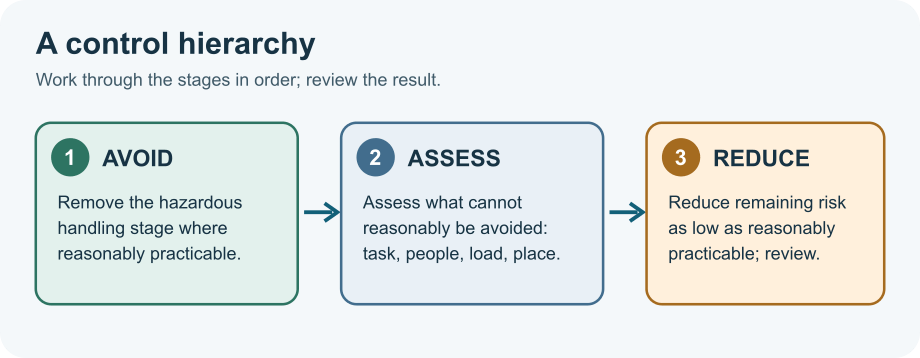 The handling-control hierarchy: avoid hazardous handling where reasonably practicable, assess what remains, and reduce remaining risk as low as reasonably practicable.
- Avoid hazardous manual handling so far as reasonably practicable. Delivery, storage and process design can remove some journeys and transfers.
- Make a suitable and sufficient assessment of unavoidable operations.
- Reduce injury risk as low as reasonably practicable through task design, suitable aids, load changes, layout and work organisation. Instruction and technique supplement those controls.
See HSE manual handling duties.
TILE factors
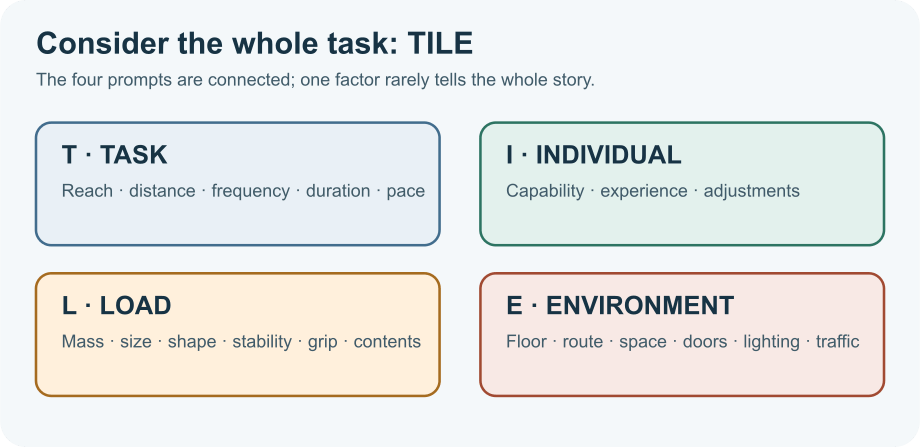 Task, Individual, Load and Environment are connected prompts for looking at the whole handling operation.
- Task: distance, frequency, duration, lift heights, reaches, turns, start/stop effort, pace and recovery.
- Individual: capability, experience, instruction, supervision, fatigue, health changes and agreed adjustments.
- Load: mass, dimensions, contents, stability, handholds, heaviest side and sharp, hot or slippery surfaces.
- Environment: floor, slopes, lighting, doors, clearances, traffic, weather and destination.
TILE is a reminder of relevant factors, not the entire assessment. Load mass or grip recorded as unknown remains unresolved until reliable information is available. Weight alone cannot establish safety; HSE screening values are not universal safe lifting limits. See HSE assessment guidance.
Recording and review
Relevant findings include who could be harmed and how, controls already in place, further actions, responsible people and timing. Existing controls and proposed changes must be distinguished. A prediction about risk after proposed controls depends on those controls being implemented and checked; it does not establish that they already work. Likelihood can fall while the possible seriousness of an injury remains high.
Worker consultation, reports and observation support review. Significant changes to loads, equipment, route, pace, people or capability can make an earlier assessment invalid. See HSE risk management guidance.
Related Topics
Further Information
Google Reviews
“Highly recommend. Sarah was lovely and delivered the course perfectly!”
Adele Collier“Great experience and very happy with the corse. Sarah delivered all aspects of the couse clearly and professionally. Loo…”
Phil Lawson“The course was extremely interesting and delivered perfectly”
Ryan Garrick“Sarah delivered the course to a high standard. Good interaction with the class and very good practical provisions.”
Neil Lefley“Couldn't of been better”
Shaun pearsall“I went onto the first aid at work course for 3 days something I was very sceptical about but right from the start Sarah …”
Daniel Connolly“Wonderful experience and met a great bunch of people. Learnt a lot and can now go ahead and put it into practice if ever…”
Spannerman“Great 3 days training from Sarah, thanks!”
Ric Smith (UK JL fan)“This was a very informative and comprehensive course. Sarah was brilliant and explained everything in layman’s terms as …”
Tracey Goodwin“The course was delivered and set at a pace that was suitable for beginners and experienced first aiders. Sarah was a rel…”
Joe Carter“Well planned, well presented, enjoyable. Sarah made me feel relaxed to engage in the course. Very informative and enjoya…”
Maria Clarke“Olly was amazing in making sure we understood everything and made sure we were all very involved”
Jackson“Great training by Olly”
Adam Hardcastle“Great session Olly was fantastic.”
Liam Duckworth“Olly was great, really informative”
Ella Souter (BR_Killjoy)“Olly”
Martin Clegg“olly was great!!!!!!!”
Emily Vidler“Olly was a fantastic trainer. He made the course fun and easy to understand. I really enjoyed the practical parts of the…”
claire thomas“Olly White was a great trainer, clear and engaging. Involved all the participants and answered all questions. Thanks”
T